
Dependency notes for Rust
A line in Cargo.toml records a crate, a version requirement and a feature list. Why the crate is there, why a feature is off, or which targets an upgrade has to be tested on does not fit on that line — and in a workspace, the same crate turns up in many members.
Pacmon keeps a note for each dependency in .pacmon/cargo/DEPENDENCY-NOTES.md, beside Cargo.toml, and shows it on the dependency's line. A workspace member without a notes file of its own uses the nearest one above it, so one file at the workspace root can cover every member.
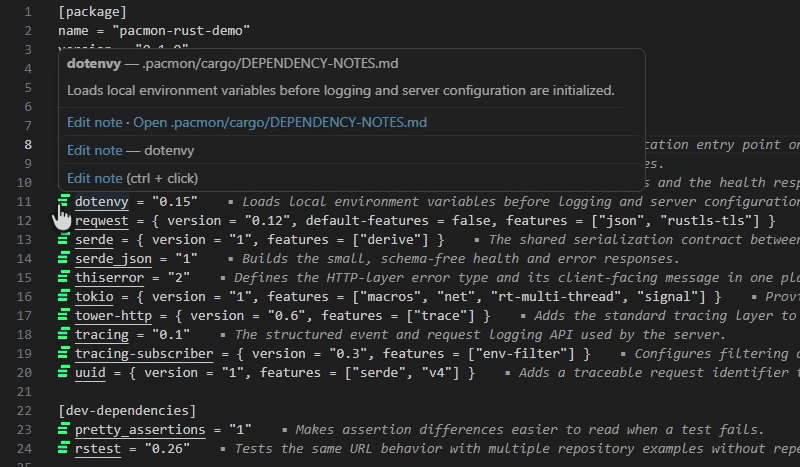
Cargo.toml in VS Code.What Pacmon reads
- Manifest:
Cargo.toml - Notes file:
.pacmon/cargo/DEPENDENCY-NOTES.md - Section heading: the dependency key, usually the crate name:
## serde
Pacmon reads [dependencies], [dev-dependencies], [build-dependencies] and their [target.…] forms. A member's serde.workspace = true counts; [workspace.dependencies] itself does not.
Pacmon never runs Cargo and does not read Cargo.lock.
Example
[dependencies]
http = "0.2"
http1 = { package = "http", version = "1" }
serde = { version = "1.0", features = ["derive"] }
tokio = { version = "1.42", features = ["rt-multi-thread", "macros"] }
.pacmon/cargo/DEPENDENCY-NOTES.md, two of its sections:
## http1

The http 1.x types, renamed so they can sit next to http 0.2 during the hyper upgrade.

### Agent notes

- purpose: request and response types for the new hyper 1 server
- remove-when: nothing uses http 0.2 any more; then rename this back to http

## tokio

Runtime for the API server and the job workers. Keep the feature list short.

### Agent notes

- purpose: async runtime for the API server and the background job workers
- constraint: no `full` feature — enable only what the code uses
- verify: `cargo test --workspace`
- verified: 1.42.0
A renamed dependency is keyed by the name the manifest gives it: ## http1 above, not ## http.
For AI coding agents
An agent reads a crate's section before it adds, upgrades or removes the crate, and records what it did under ### Agent notes. remove-when: tells it when a dependency has served its purpose. See the rules agents follow.