
Dependency notes for Zig
build.zig.zon pins each dependency to a URL and a hash, or to a local path. The hash says exactly what was fetched. It says nothing about why, which commit was tested, or what has to be checked before it is replaced.
Pacmon keeps a note for each dependency in .pacmon/zig/DEPENDENCY-NOTES.md, beside build.zig.zon, and shows it on the dependency's field.
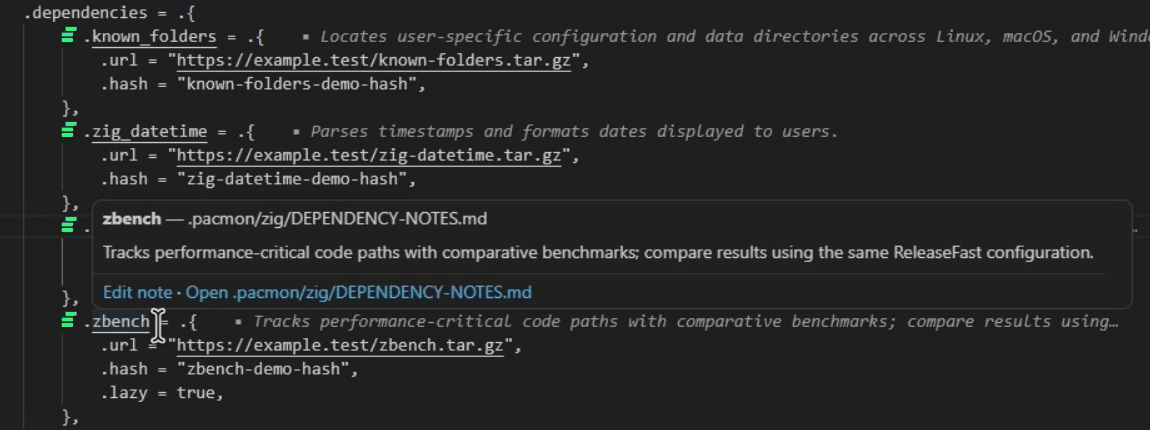
build.zig.zon in VS Code.What Pacmon reads
- Manifest:
build.zig.zon - Notes file:
.pacmon/zig/DEPENDENCY-NOTES.md - Section heading: the direct dependency field:
## known_folders
Pacmon reads direct fields of the top-level .dependencies struct in build.zig.zon, including URL/hash, path and lazy dependencies. build.zig, system libraries and transitive dependencies are not evaluated.
Pacmon never runs Zig, so it needs no Zig toolchain.
Example
.dependencies = .{
    .known_folders = .{
        .url = "git+https://github.com/ziglibs/known-folders#…",
        .hash = "…",
    },
    .zlib = .{
        .path = "deps/zlib",
    },
},
.pacmon/zig/DEPENDENCY-NOTES.md:
## known_folders

Finds the config and cache directories on each OS.

### Agent notes

- purpose: finds the user's config and cache directories on Linux, macOS and Windows
- constraint: change `.url` and `.hash` together, with `zig fetch --save`
- verify: `zig build test` on Linux and on Windows
The heading is the field name in .dependencies: .known_folders is ## known_folders, and an escaped name such as .@"known-folders" is ## known-folders.
For AI coding agents
An agent reads a dependency's section before it adds, updates or removes it, and logs what it did under ### Agent notes. See the rules agents follow.